
Lamar County Court Arrest Records
After a Lamar County arrest, two record tracks may exist at the same time. The first is the jail track, created when a person is booked into local custody. It may show booking status, bond data, holds, and release or transfer information. The second is the court track, created when a prosecutor files a complaint, information, or indictment and the clerk opens a criminal case. That court record is where the formal filed charge, court name, case number, calendar settings, docket events, orders, plea, dismissal, judgment, or sentence should appear.
The Lamar County Odyssey Public Access portal is the main online route located in the research. Its public landing text identifies Case Records, Criminal Records, Court Calendar, Jail Records, and Jail Bond Records. Use Criminal Records and Court Calendar for court records after a jail arrest. Use Lamar County jail inmate records when the question is current custody or booking status. Use Lamar County jail mugshots only for booking-photo availability, because the court case file is not a mugshot gallery.
Search Lamar County Court Records
Start with the Lamar County Odyssey Public Access portal. Choose Criminal Records when the question is what charge was filed after arrest. Choose Court Calendar when the question is the next hearing. If the arrest is very recent, the jail booking may appear before the court case. In that gap, call the sheriff or jail line at 903-737-2400 and search again after the prosecutor and clerk have had time to process the filing.
- Open the Odyssey Public Access portal and choose the criminal-record or court-calendar area if the live portal displays those categories.
- Search by defendant name when the case number is not known. Use the case number from bond paperwork, jail paperwork, or clerk notice when available.
- Open the case result and compare the court, case number, party name, filed charge, docket entries, and next setting.
- Check Jail Bond Records or call the jail if the question is still release status, bond type, or a no-bond hold.
The Lamar County Clerk self-service portal is also an official county record channel, but the research describes it as a clerk public-service portal rather than the primary jail-arrest case path. Certified court records should come from the clerk or court that keeps the file, not from a screen capture or copied search result.
| Field | Type | Use | Research Status |
|---|---|---|---|
| Case Records | Category | Parent route for court cases | Confirmed in portal landing text |
| Criminal Records | Category | Filed charges after arrest | Confirmed in portal landing text |
| Court Calendar | Category | Future hearings and settings | Confirmed in portal landing text |
| Party or defendant name | Text | Name search when the case number is unknown | Inferred from Odyssey case-search patterns |
| Case number | Text | Best exact search key once known | Supported by cached Lamar case examples |
| Date range | Date fields | Calendar or docket narrowing if shown | Not verified on live Lamar form |
The official Odyssey Public Access landing page shows the local court and jail record categories used for Lamar County searches.
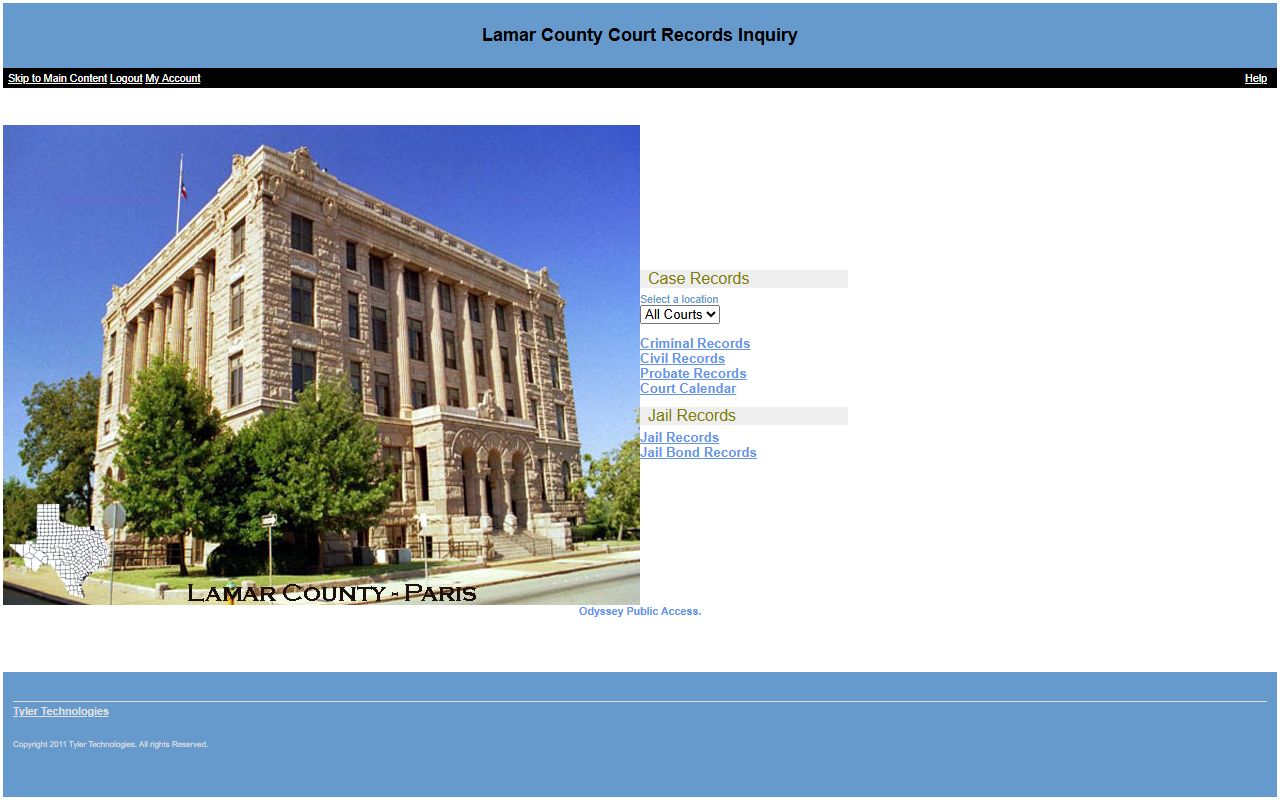
That portal screenshot supports the local search path: court records after an arrest are searched through Criminal Records and Court Calendar, while custody questions stay with Jail Records or Jail Bond Records.
Lamar County Arrest Court Path
The local sequence is arrest, booking, magistrate or bond review, prosecutor review, clerk filing, then court calendar and docket activity. The arresting agency may list an initial offense at booking. That entry is not always the same as the filed court charge. The prosecutor can accept a charge, reject it, change it, seek an indictment, or proceed by complaint or information depending on the facts and offense level. Once the charge is filed, the case appears in the name of the State of Texas against the defendant.
Lamar County research found public examples of criminal cases styled as State of Texas versus a defendant in courts such as County Court at Law, 6th District Court, 62nd District Court, and Justice of the Peace 5-1. Those examples show why a court-record search needs more than a name. A misdemeanor, felony, warrant matter, and lower-court case may sit in different courts even when all stem from the same arrest event.
| Document | Who Uses It | Common Role |
|---|---|---|
| Complaint | Officer, prosecutor, or complainant under court rules | States the accusation and can support a misdemeanor or early criminal filing. |
| Information | Prosecutor | Formal charging document often used when a grand-jury indictment is not the charging route. |
| Indictment | Grand jury | Formal felony accusation returned after grand-jury review. |
Lamar County Charge Status
A charge can move through several public statuses before the case ends. A pending charge is an accusation. It can be amended, reduced, enhanced, dismissed, rejected, pled, deferred, or sentenced. The jail charge may stay tied to the booking while the court charge changes in the criminal case. For that reason, a Lamar County court records after arrest search should compare the jail or bond record with the Criminal Records docket rather than treating the first booking label as the final prosecution result.
| Status | Meaning | What to Check |
|---|---|---|
| Pending | The charge is filed and unresolved. | Next court date, bond conditions, and docket entries. |
| Amended | The prosecutor changed the charge text, level, count, or allegation. | Latest charging document and docket event. |
| Reduced | The case moved to a lesser offense or lower charge level. | Plea papers, amended information, or judgment. |
| Dismissed | The court case or count was dropped and is not a conviction. | Dismissal order and whether expunction may be available. |
| Sentenced | A judgment or sentence has been entered after plea, trial, or other disposition. | Judgment, sentence, jail credit, and TDCJ transfer status. |
Lamar County Bond Warrants
Bond is part of the court and jail path after an arrest. Texas Code of Criminal Procedure Chapter 17 governs bail, conditions, and release decisions. Lamar County Odyssey advertises Jail Bond Records, so online bond data may appear there when the live portal exposes that category. If no online entry is visible, the practical route is to call 903-737-2400, confirm the exact charge, ask whether there are multiple cases, and ask whether any hold blocks release.
Warrants can also shape the court record after arrest. Texas Code of Criminal Procedure Chapter 15 covers arrest under warrant. The research did not locate a separate Lamar County sheriff active-warrant search page. Check Odyssey Criminal Records and Court Calendar for court events, contact the court that issued the warrant, and use caution with in-person inquiries because an active warrant can lead to arrest. A parole warrant, other-county warrant, federal hold, or ICE detainer may keep a person in jail even after local bond is posted.
| Bond or Hold | How It Affects Release |
|---|---|
| Cash bond | Money is paid directly under court and jail rules to secure release and future appearance. |
| Surety bond | A licensed bondsman posts the bond after separate premium and collateral terms. |
| Personal bond | Release is based on a signed promise and court conditions rather than full cash deposit. |
| No-bond hold | Payment alone will not release the person until a judge or agency changes the hold. |
| Detainer | Another agency requests continued custody, often for parole, another county, federal, or immigration matters. |
Lamar County Charges Convictions
An arrest and a filed charge are not convictions. A charge is the government's formal claim that an offense occurred. A conviction follows a guilty plea, verdict, or judgment. A dismissed charge is not a conviction, and a jail booking can remain historically true even when the court case later ends in dismissal or a different offense. This distinction matters for Lamar County court records after arrest because a quick name search may show both old accusations and final results.
| Point | Charge | Conviction |
|---|---|---|
| Stage | Accusation filed in court | Final finding or plea entered by the court |
| Proof | Based on complaint, information, indictment, or probable cause | Requires plea, verdict, or judgment under criminal procedure |
| Possible result | Pending, amended, reduced, dismissed, or sentenced | Sentence, probation, fine, jail credit, or other judgment terms |
| Search tip | Read the latest docket entries before drawing conclusions | Use the judgment or disposition, not the booking label alone |
Lamar County Sealed Expunged Records
Texas public access starts with the Texas Public Information Act, but not every record is released online or at the counter. Juvenile data, confidential victim information, active investigative material, sealed files, expunged records, and protected identifiers may be withheld or redacted. Texas Code of Criminal Procedure Chapter 55A governs expunction, which can require eligible criminal records to be destroyed, returned, or treated as though the arrest did not occur.
| Issue | Sealed or Restricted | Expunged |
|---|---|---|
| Public view | Hidden or limited from ordinary public access | Removed from public record under a court order |
| Government access | Some agencies may retain limited access under law | Access is much narrower and controlled by the expunction order |
| Best source | Read the sealing or nondisclosure order | Read the Chapter 55A expunction order |
| Search result | A public portal may omit or redact the case | A public portal should not keep displaying the expunged record |
Important: Lamar County Inmate Population is not a consumer reporting agency, and these records are not for employment, credit, housing, insurance, or other FCRA-covered screening.
Lamar County Public Access
When the desired court record is not online, contact the clerk or court that maintains the file. When the desired jail booking sheet, bond status, or custody record is not online, contact the Lamar County Sheriff's Office or Jail Administration. When the arrest began with Paris Police, that department may hold the police incident or offense report, while the sheriff holds the jail booking record and the clerk holds the court file.
The Paris Police Records Division states that open-records requests must be written, are not accepted by telephone, and must include requester contact information. Paris lists basic public copies at 10 cents per page and notes that requests needing an Attorney General opinion may take up to 10 business days. Those details are for Paris Police records, not a Lamar County sheriff fee schedule, but they show why the right custodian matters after an arrest.
Sentencing can move the custody search outside Lamar County. If a felony sentence results in state prison transfer, use the TDCJ Inmate Search. If a person is in federal prison, use the BOP Inmate Locator. Immigration custody is searched through ICE ODLS. These locators do not replace Lamar County court records, but they help confirm where the person is held after the local case changes custody status.